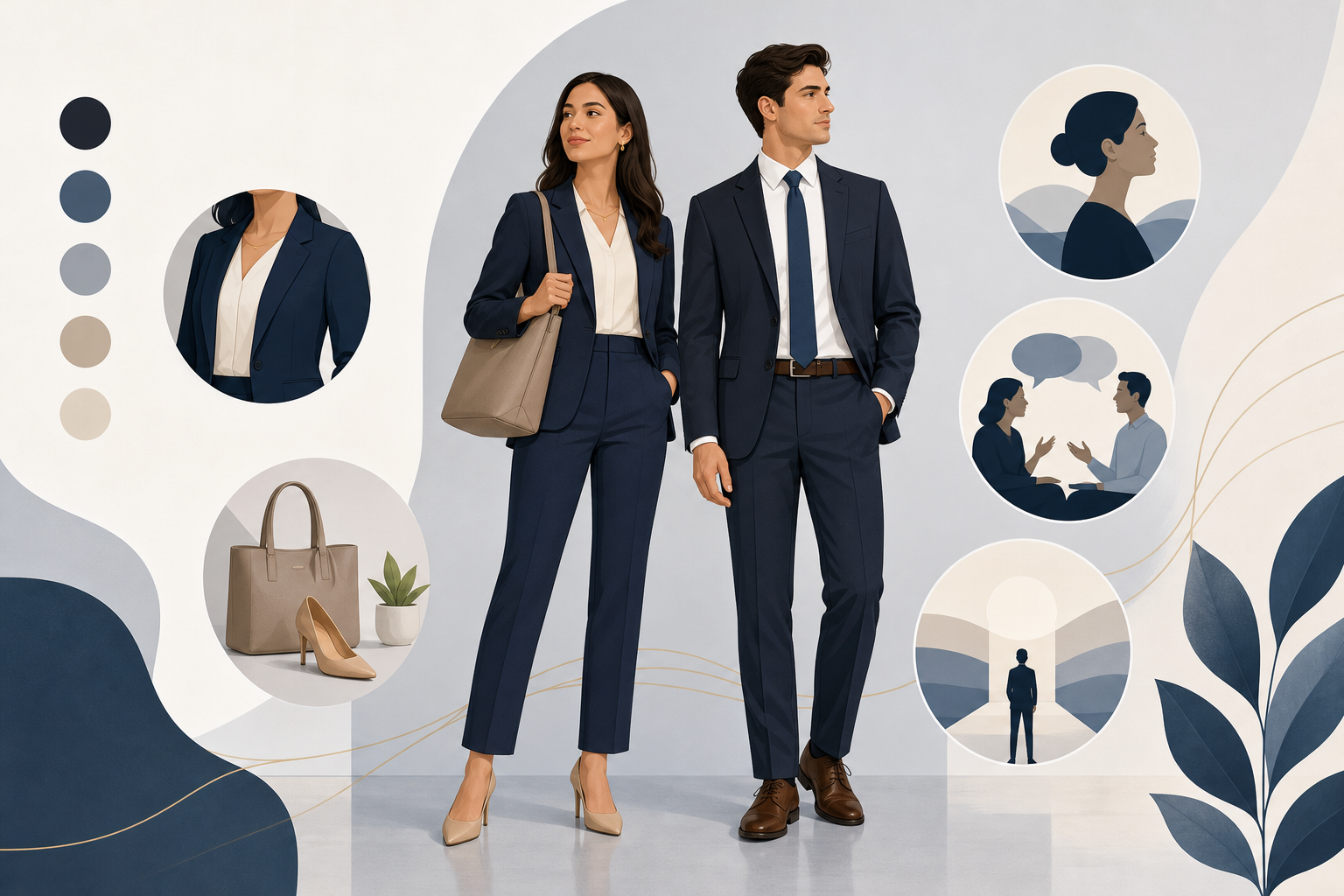
Your first interview outfit should help you feel prepared, not like you are wearing someone else’s identity. If you are wondering what to wear to an entry-level interview in 2026, start with the employer’s working environment rather than a universal rule about suits.
Post-remote-work dress norms vary across teams, even within the same company. A startup’s business casual might include clean sneakers, while a bank’s version might mean tailored trousers and a collared shirt.
Your most reliable starting point is simple: dress one notch above the team’s normal daily attire. Then adjust for the role, interview format, and any explicit instructions.
What to Wear to an Entry-Level Interview: The One-Notch Rule
“One notch above” means slightly more polished, not dramatically more formal. You want to show that you understand the environment and recognize that an interview is an important professional conversation.
Use this translation:
- The team wears T-shirts and jeans: Choose a plain knit top, polo, or casual button-down with chinos or tailored trousers.
- The team wears polos and chinos: Choose a pressed shirt or blouse with tailored trousers. Consider an unstructured blazer.
- The team wears business casual: Add a blazer or choose a coordinated, more formal outfit with polished shoes.
- The team wears suits: Wear a suit or similarly formal coordinated outfit. Do not search for an even more elaborate option.
Explicit instructions come first. If the recruiter specifies business professional, safety footwear, or another requirement, follow that guidance rather than estimating from employee photos.
Treat this rule as a decision tool, not a guarantee. Your goal is appropriate polish while staying comfortable enough to listen, think, and answer clearly.
How to Research the Dress Code Before Your Interview
You do not need to guess based on the company’s industry alone. Find evidence about the specific office, department, and role.
- Read the invitation carefully. Look for dress guidance, walking tours, practical assessments, or protective-equipment requirements.
- Check recent workplace photos. Prioritize ordinary office scenes over awards ceremonies, recruiting campaigns, or old event photos.
- Consider who you will meet. A client-facing interview may call for more formality than an internal technical conversation.
- Ask the recruiter directly. Write: “Could you share the expected dress code for the interview? Would business casual be appropriate, or would you recommend business professional?”
For additional company-specific context, you can check free interview reports by company. Treat candidate accounts as clues, not official dress-code instructions, and prioritize recent reports for a similar role or location.
If you cannot get a clear answer, a polished business casual outfit is a practical starting point for many office roles. Traditional finance, law, and other formal settings deserve a more conservative default.
Business Casual Interview Outfits by Industry in 2026
Business casual is not one standardized uniform. Use these examples as starting points, then check the employer’s expectations.
Startups and Technology Companies
At a casual startup, a full suit can be unnecessary. A clean, intentional outfit usually makes more sense than copying the most relaxed person in an office photo.
Try: Chinos or tailored trousers, a solid-color knit top, polo, or button-down, and clean loafers, flats, or simple sneakers if the workplace clearly accepts them.
For enterprise sales, consulting-style customer roles, or meetings with senior clients, add a blazer and choose more formal shoes. A software startup and a financial technology company may have very different expectations.
Banking, Finance, and Insurance
Separate traditional client-facing roles from less formal internal teams. Investment banking interviews often call for business professional attire, while some operations, analytics, and insurance teams accept business casual.
Try: A navy or charcoal suit, or a coordinated blazer with tailored trousers, a skirt, or a structured dress. Add a shirt or blouse and polished shoes. A tie may be appropriate in more traditional settings.
If the dress code is unclear for a traditional banking interview, choose the more formal option. You can always ask whether a suit is expected.
Consulting, Accounting, and Law
These employers may assess how you would present yourself to clients, even when their everyday office dress is relaxed. Interview expectations can therefore be more formal than employee workwear.
Try: A suit or coordinated blazer-and-trouser outfit, a simple shirt or blouse, and polished shoes.
For a small accounting practice or legal support role, business casual may be sufficient. Confirm rather than assuming every professional-services firm uses the same standard.
Marketing, Design, Media, and Creative Agencies
Creative workplaces often allow more personal expression, but that does not mean your outfit should compete with your portfolio or answers.
Try: Tailored trousers with a textured knit, an understated dress, or a relaxed blazer with a simple top. One distinctive accessory or color can express your style without creating distractions.
For client-facing account roles, lean more polished. For studio roles, prioritize an intentional outfit that lets you move comfortably.
Healthcare, Education, Government, and Nonprofits
These sectors are too varied for a single dress rule. A hospital administrator, classroom assistant, and government analyst may face different expectations.
Try: Trousers with a shirt, blouse, or neat knit, or a comfortable dress with an optional blazer or cardigan.
Do not assume a clinical interview requires scrubs. Ask whether you will enter clinical areas and whether specific clothing or footwear is required. For school visits, choose an outfit that remains comfortable while walking, sitting, or bending.
Retail, Hospitality, Manufacturing, and Skilled Roles
Match the setting while showing that you take the opportunity seriously. A luxury hotel may expect greater formality than a casual café, warehouse, or workshop.
Try: A polo or button-down with chinos and clean closed-toe shoes. For upscale hospitality or retail, consider tailored separates or a suit if requested.
For site tours or practical assessments, ask about footwear and safety requirements. Do not substitute appearance for protection or assume you should bring equipment without instructions.
Build a Polished Interview Outfit Without Overspending
For an entry-level interview, you rarely need an entirely new wardrobe. Fit, condition, and coordination matter more than labels.
Start with one outfit you can reuse:
- One pair of comfortable tailored trousers, or a suitable skirt or dress.
- One clean, opaque top that sits comfortably at the neckline and shoulders.
- One optional layer, such as a blazer or cardigan.
- One pair of clean shoes you can walk in confidently.
Choose colors that work together rather than trying to follow a trend. Navy, charcoal, black, cream, and muted colors are easy to combine, but brighter colors can work when appropriate to the setting.
Before buying anything, try borrowing a blazer, checking a thrift store, or asking your college career center about interview-clothing resources. If your budget is limited, prioritize cleaning, pressing, and small repairs over buying a matching suit for a casual employer.
Test the Outfit While Seated
Stand in front of a mirror, then sit as you would during the interview. Check for pulling buttons, shifting necklines, uncomfortable waistbands, or hems you keep adjusting.
Walk, reach for a bag, and practice a greeting. If an item demands constant attention at home, it may interrupt your concentration during a behavioral question.
What to Wear to a Virtual Entry-Level Interview
A video interview is still an interview. Match the employer’s level of formality rather than assuming that being at home makes casual clothing appropriate.
Run a short camera test in the actual interview location:
- Check contrast: Your top should be distinguishable from the background.
- Avoid distracting patterns: Tight stripes and small checks can create visual distortion on camera.
- Test accessories: Notice jewelry noise, glare, or items that hit your microphone.
- Check framing: Make sure your collar, neckline, and any blazer look natural while seated.
- Wear a complete outfit: You may need to stand up unexpectedly.
Lighting can change how colors and fabrics appear. Use your device’s recording function to check both the picture and sound before interview day.
Make Your Outfit Support Your Behavioral Interview Answers
Clothing cannot replace strong examples, but it can remove distractions. During a behavioral interview, you need enough mental space to recall details, explain your decisions, and respond to follow-up questions.
Practice one answer while wearing your interview outfit. Use the STAR method: Situation, Task, Action, Result.
For example, if asked, “Tell me about a time you adapted to an unfamiliar environment,” you might structure an answer around a real student-job experience:
- Situation: You joined a campus office during a busy enrollment period.
- Task: You needed to support students while learning unfamiliar procedures.
- Action: You observed an experienced colleague, clarified expectations, and created a checklist for common requests.
- Result: Explain what actually improved, such as completing requests independently or receiving positive supervisor feedback.
Use your own experience and only claim outcomes you can support. While rehearsing, notice whether your shoes, sleeves, or accessories make you fidget. Fix those issues before they compete with your story.
Handle Personal Style, Accessibility, and Comfort
Professional presentation does not require abandoning your identity. Choose clothing that works with your gender expression, religious dress, cultural practices, sensory needs, and mobility requirements.
You do not need heels, makeup, or a particular hairstyle to demonstrate competence. Aim for an outfit that is appropriate to the setting and manageable for you.
If a practical assessment or site visit creates an accessibility concern, ask about the activity and available arrangements ahead of time. Specific information is more useful than trying to accommodate an unknown situation through clothing alone.
Your Final Interview Outfit Checklist
The evening before your interview:
- Confirm the dress code, location, weather, and any site requirements.
- Check for stains, wrinkles, loose threads, and missing buttons.
- Clean your shoes and prepare a comfortable travel option if needed.
- Keep fragrance minimal or skip it, especially in shared spaces.
- Pack your documents and choose a backup top.
- Rehearse one behavioral answer in the complete outfit.
The best interview outfit helps you stop thinking about your outfit. Research the team, dress one notch above its daily norm, and follow explicit instructions. Then put your attention where it belongs: showing how you communicate, learn, solve problems, and contribute.