
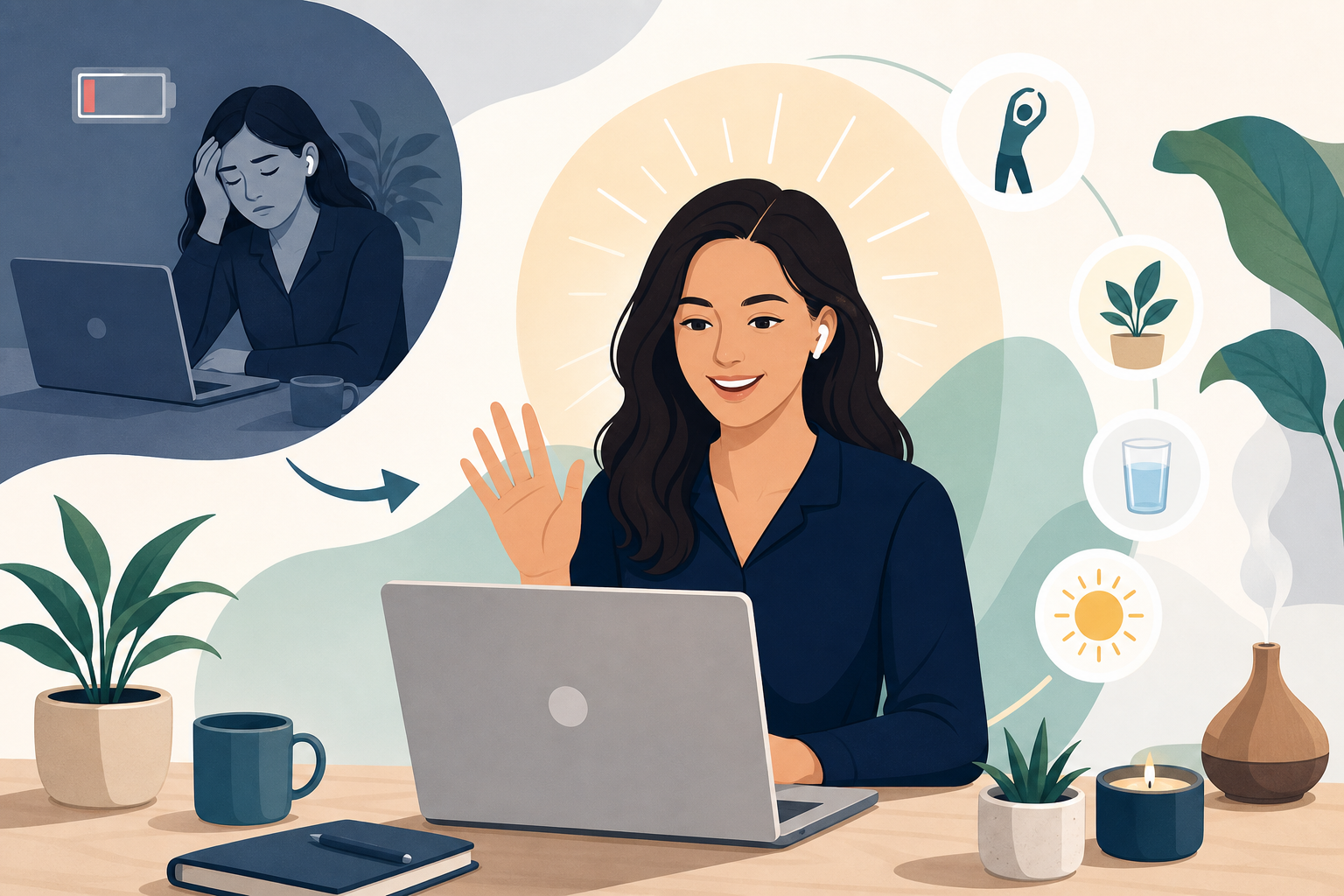
Introduction: how to keep your energy up on camera when video calls drain you
Video interviews can feel uniquely exhausting. You are trying to connect, think clearly, and show confidence, while staring at a lens and monitoring your own face. If you want to keep your energy up on camera without sounding fake, you need a plan that reduces camera fatigue and supports your natural presence.
This guide focuses on interview psychology and practical tactics you can use immediately. You will learn how to hide self-view, set up gesture space, do quick vocal warm-ups, and follow a 10-minute pre-call routine that boosts on-screen energy in a grounded way.
Your goal is not to “perform.” Your goal is to make it easy for the interviewer to feel your clarity, warmth, and confidence through a screen.
Why video calls drain you, especially in behavioral interviews
Behavioral interviews are cognitively heavy. You are retrieving specific memories, structuring answers, reading the interviewer’s reactions, and monitoring time. On video, you add extra load.
The hidden causes of camera fatigue
- Self-monitoring overload: Seeing your own face makes you evaluate yourself while speaking. That splits attention and increases stress.
- Reduced nonverbal feedback: Tiny delays, frozen frames, and limited body language make it harder to “feel” connection.
- Stiff posture: Many people freeze their shoulders and hands to stay “professional,” which lowers energy and vocal variety.
- Eye contact confusion: Looking at the person’s face on-screen is not the same as looking into the camera. You end up feeling less connected, even when you are doing fine.
What “high energy” actually means on camera
On camera, energy is less about being loud or bubbly. It is about:
- Vocal variety: clear pace, strong endings, intentional pauses.
- Facial engagement: relaxed eyes, slight smile readiness.
- Movement that supports meaning: small gestures that emphasize points.
- Mental sharpness: quick access to your STAR stories without rambling.
Hide self-view: the fastest way to reduce video interview fatigue
If you do one thing today, do this. Hide self-view during your interview practice and the real call.
Why it works
When you can see yourself, your brain treats the call like a mirror plus a performance. You start adjusting your face, hair, posture, and expressions mid-sentence. That steals bandwidth you need for thinking and listening.
How to use it in interviews
- Turn self-view off as soon as you confirm your framing and lighting.
- If you worry about looking “off,” do a quick check at the start, then hide it again.
- Practice with self-view hidden so it feels normal.
A strong interview is built on presence and clarity, not constant self-correction.
Create gesture space: look more confident and feel more energized
Your body affects your mind. If you lock your arms and minimize movement, your voice often flattens and your answers get more monotone.
Set up your physical frame for natural movement
- Camera distance: Aim for mid-torso to head framing. If your camera is too close, you will avoid gesturing.
- Chair position: Sit far enough back that your shoulders are relaxed, not hunched toward the screen.
- Desk space: Clear the area in front of you so your forearms can move freely.
- Hands visible sometimes: You do not need constant hand visibility, but letting hands appear occasionally can increase perceived warmth and clarity.
Interview-friendly gestures that read well on camera
Use small, controlled gestures near chest level.
- “Three points” gesture: lightly count on fingers near your torso.
- “Contrast” gesture: one hand slightly left, one slightly right to compare options.
- “Timeline” gesture: small forward motion to show progression.
Avoid big sweeping motions that leave the frame. The goal is meaningful movement, not distraction.
Vocal warm-ups: sound energized without forcing it
Camera drains often show up first in your voice. You may sound quieter, flatter, or rushed. A short warm-up can make you sound more confident immediately.
A 2-minute vocal warm-up that works before interviews
- Breath reset (20 seconds): inhale through your nose for 4, exhale for 6. Do 3 cycles.
- Lip trill or hum (30 seconds): gentle lip buzz or humming to wake up resonance.
- Articulation (30 seconds): say slowly, “red leather, yellow leather,” or “unique New York,” focusing on crisp consonants.
- Pitch glide (20 seconds): hum from low to medium pitch and back down.
- Power endings (20 seconds): say 3 sentences with firm endings, not trailing off.
On-call vocal habits that keep energy steady
- End sentences cleanly. Avoid fading at the end, it reads as uncertainty.
- Use short pauses after key points. Pauses signal confidence and prevent rambling.
- Slow down slightly when describing results. Clarity feels like confidence.
The 10-minute pre-call routine that raises on-screen energy without faking it
This routine is designed for job seekers preparing for behavioral interviews. It boosts clarity and warmth while reducing stress. It also prevents the “I logged in cold and now I sound tired” problem.
Minute 10 to 8: reset your body
- Stand up.
- Roll shoulders back and down.
- Do 5 slow neck turns and 5 shoulder circles.
- Take 3 deep breaths with longer exhales.
Why it works: you release tension that tightens your voice and facial muscles.
Minute 8 to 6: light movement to elevate alertness
Choose one option:
- 20 bodyweight squats, slow and controlled.
- A brisk walk around your room.
- 30 seconds of marching in place, then 30 seconds of shaking out arms.
Why it works: you increase circulation so you look and sound more awake.
Minute 6 to 4: vocal warm-up
Use the 2-minute warm-up above. If you are short on time, do breath reset plus humming plus power endings.
Why it works: your first 60 seconds on the call will sound confident, not tentative.
Minute 4 to 2: prime your STAR stories
Open a single page with your story prompts. Do not open ten documents.
- Pick two core stories that cover common behavioral themes: conflict, ownership, failure, ambiguity, leadership.
- For each story, say out loud:
- Situation in 1 sentence
- Task in 1 sentence
- Actions in 3 bullet points
- Result in 1 sentence
Why it works: you reduce retrieval effort during the interview, which lowers fatigue and improves delivery.
Minute 2 to 0: camera and mindset lock-in
- Confirm camera framing, then hide self-view.
- Put your notes at eye level, close to the camera.
- Decide your “energy intention” in one phrase: “calm and direct,” or “warm and concise.”
Why it works: you stop overthinking and start showing up with a clear style.
On-camera behaviors that read as energetic and confident
These are small adjustments that make a big difference in how you come across.
Use “camera glances” instead of constant camera staring
You do not need to stare into the lens nonstop. That can feel intense.
Try this pattern:
- Listen while looking at the interviewer’s face on-screen.
- When you deliver your main point or result, glance at the camera for 1 to 2 seconds.
- Return to the interviewer’s face.
This creates moments of direct connection without making you stiff.
Use a slightly slower pace than you think you need
Video compresses nuance. If you speak too fast, you will sound anxious and your stories will blur.
A practical rule:
- Slow down at the start of each STAR section.
- Pause briefly before the Result.
- Let the result land with a clear final sentence.
Make your first answer your energy anchor
Your first question is often, “Tell me about yourself,” or “Walk me through your resume.” Prepare it like an opening statement.
Structure:
- Present role and focus.
- 1 to 2 strengths relevant to the role.
- A quick transition to why you are excited about this job.
If you start strong, your energy tends to stay strong.
STAR method examples that keep energy high and answers tight
When you feel drained, your answers can become long and meandering. STAR gives you rails. Here are two examples designed for video delivery.
Example 1: “Tell me about a time you handled conflict”
Situation: “On a cross-functional project, our design and engineering teams disagreed on a feature scope two weeks before launch.”
Task: “I needed to unblock the team and protect the launch date without sacrificing user experience.”
Action:
- “I scheduled a 30-minute alignment call with a clear agenda and decision criteria.”
- “I asked each team to share the risk of their preferred approach, then summarized the tradeoffs neutrally.”
- “I proposed a phased solution: ship the core flow now, and commit to the enhancement in the next sprint with acceptance criteria.”
Result: “We launched on time, reduced rework, and the teams left with a shared definition of done for future changes.”
Why it keeps energy up: short sentences, clear verbs, and a clean result. You can deliver it with calm confidence.
Example 2: “Tell me about a time you made a mistake”
Situation: “I sent a client an update that included an outdated timeline because I referenced the wrong document.”
Task: “I needed to correct the information quickly and rebuild trust.”
Action:
- “I notified the client immediately and clarified the accurate timeline in writing.”
- “I took ownership and explained the process gap, not excuses.”
- “I implemented a version-control step: one source of truth and a final checklist before sending updates.”
Result: “The client appreciated the transparency, and we avoided similar errors for the rest of the engagement.”
Why it keeps energy up: it is honest, structured, and ends with control and learning.
Manage your environment to prevent energy leaks
You can do everything right and still feel drained if your setup is working against you.
Lighting and camera angle that reduce strain
- Put a light source in front of you, not behind you.
- Raise your camera to eye level. Looking down can make you look tired and compress your breathing.
- Increase font sizes on your screen so you are not squinting.
Sound setup that reduces cognitive load
- Use headphones or a dedicated mic if possible.
- Close noisy apps and silence notifications.
- If you can, use wired internet or sit closer to your router to avoid lag that breaks conversational rhythm.
Use micro-recovery during the interview
Even strong candidates dip in energy mid-call. You can recover quickly without anyone noticing.
Two subtle resets you can do live
- Breath reset while listening: inhale quietly through the nose, exhale slowly through the mouth while the interviewer is speaking.
- Posture reset: plant both feet, relax shoulders, and lengthen your spine. This often improves vocal tone immediately.
If you blank on a story, buy time confidently
Use a calm bridging line:
- “Let me choose an example that best matches what you are asking. One moment.”
- “Yes, I have a good example. I want to pick the one with the clearest outcome.”
Then glance at your story prompts and proceed.
Practice in a way that builds real on-camera stamina
If video drains you, practicing only in your head will not fix it. You need short, realistic reps.
A simple practice plan for the week before interviews
- Do one 15-minute mock on camera per day.
- Hide self-view during the mock.
- Record and review only two things:
- your pacing and pauses
- whether your Result is clear and specific
- Repeat the same two STAR stories until they feel automatic.
If you want extra help tailoring your preparation to a specific employer, you can review free interview reports by company here: https://primly.io/community. Use it to anticipate themes and pick stories that match what that company tends to value.
Conclusion: show up energized by design, not by force
To keep your energy up on camera, you do not need to fake enthusiasm. You need to remove the drains and support your natural presence.
Use these four pillars:
- Hide self-view to reduce self-monitoring.
- Build gesture space so your body can support your voice.
- Do quick vocal warm-ups to sound confident from the first minute.
- Follow the 10-minute pre-call routine to arrive alert, grounded, and ready.
Pick one tactic to implement today, then add the others over the next week. When your setup and routine do the heavy lifting, you can focus on what matters most in behavioral interviews: clear stories, strong results, and a calm, credible delivery.