
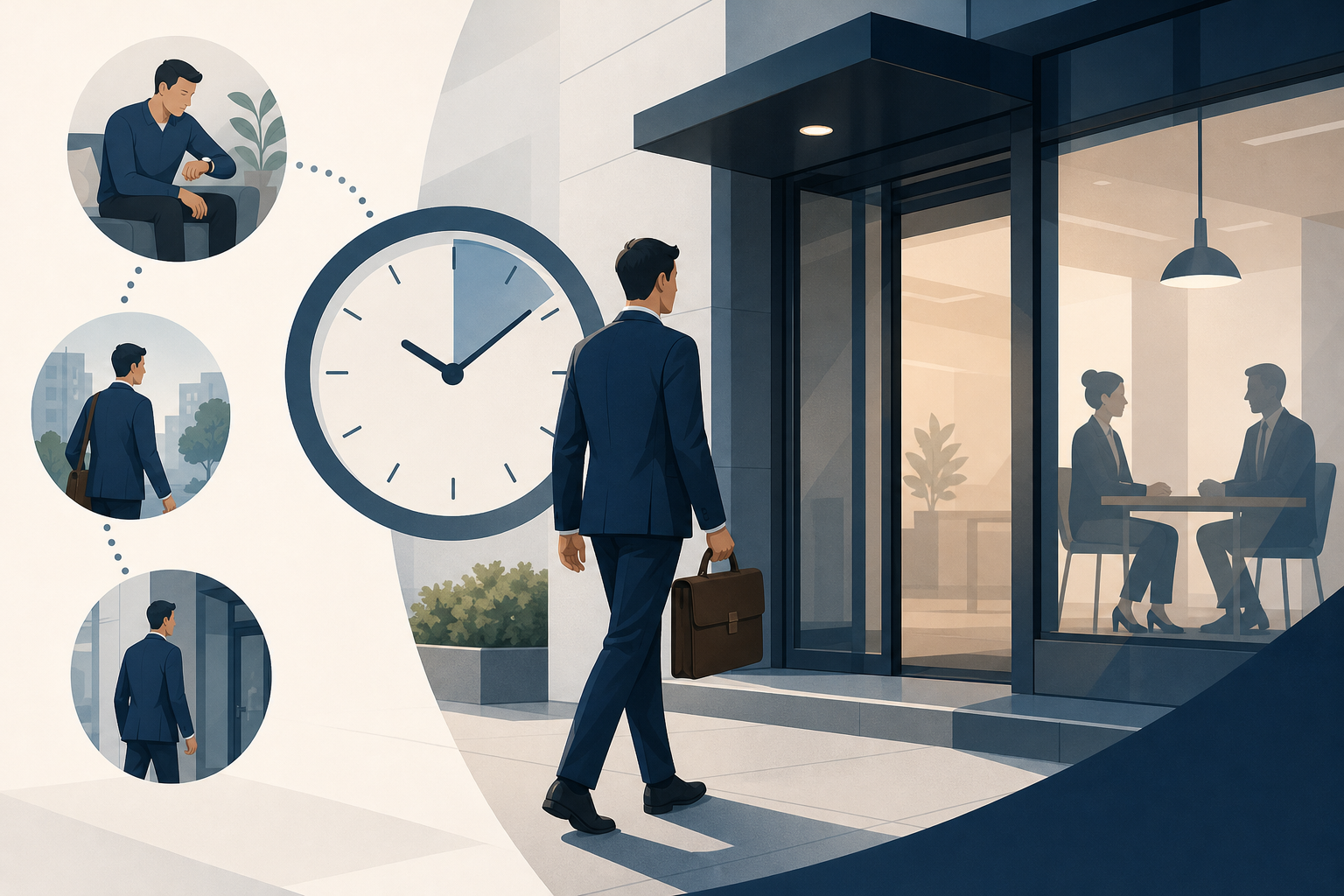
Introduction: How early should you arrive for an interview?
How early should you arrive for an interview to make a strong first impression without creating awkwardness. A reliable guideline is the 10-minute rule for in-person interviews and the 2-minute rule for video interviews. These targets help you show up calm, prepared, and professional, which matters in behavioral interviews where your composure and clarity are part of the evaluation.
What surprises many candidates is that very early arrival can be a real problem, not a bonus. It can disrupt the interviewer’s schedule, create pressure on the front desk, and signal poor judgment about professional boundaries.
This tactical guide gives you a clear arrival plan, explains why “too early” backfires, and shows you exactly what to do with buffer time so you perform better in the interview.
The rule of thumb: 10 minutes in-person, 2 minutes video
The 10-minute rule for in-person interviews
Aim to be in the building lobby or nearby 15 to 20 minutes early, but check in at reception 10 minutes before your scheduled start time.
This gives you enough cushion for:
- Security check, visitor badge, elevators
- Finding the right suite or floor
- A quick reset if transit runs late
It also respects the interviewer’s calendar. Many interviewers schedule back-to-back meetings. If you check in too early, the staff may feel obligated to “do something with you,” which can create friction before you even start.
The 2-minute rule for video interviews
For video interviews, be fully ready earlier, but join the call 1 to 2 minutes before the scheduled time.
That means:
- Camera on, lighting set, microphone tested
- Notes open, water ready
- Notifications silenced
Joining 10 minutes early to a video call can create awkwardness if the interviewer joins and feels rushed to start, or if you appear to be “waiting in the room” while they are finishing another meeting.
Key idea: Be ready early. Arrive or join slightly early.
Why arriving very early can hurt your chances
It can create pressure on the front desk and hiring team
If you show up 25 to 40 minutes early and check in, the receptionist has limited options. They may:
- Interrupt the interviewer to ask if they can take you early
- Seat you in a visible waiting area where you feel exposed
- Leave you waiting with no clear plan, which increases your anxiety
None of this makes you look more dedicated. It can read as poor planning or misunderstanding of workplace flow.
It can signal boundary issues
Interviewing is partly about trust and judgment. Showing up extremely early can unintentionally communicate:
- You expect others to adjust to you
- You do not understand professional timing norms
- You are trying to force extra time or attention
In roles that require coordination, client management, or executive presence, this can be a yellow flag.
It can drain your energy before the interview starts
Waiting too long in a lobby is not neutral. It often increases stress because you are:
- Watching people pass by
- Overthinking answers
- Sitting in an unfamiliar environment with limited control
Behavioral interviews reward calm recall and structured storytelling. Extra waiting time can make you ramble, rush, or second-guess.
It can disrupt your warm-up routine
Your best performance usually comes from a short, focused warm-up. If you arrive too early and have nothing productive to do, you might:
- Scroll your phone and lose focus
- Re-read your resume obsessively
- Burn mental energy trying to “stay ready”
The right arrival time protects your mental bandwidth.
What “arrive” actually means: define your checkpoints
A practical way to plan is to define three separate times.
1) Arrival zone time
This is when you get close enough that a small delay will not make you late.
- In-person: arrive 15 to 20 minutes early to the neighborhood or parking area
- Video: be at your desk and fully set up 10 to 15 minutes early
2) Ready-to-start time
This is when you are composed and technically ready.
- In-person: phone silenced, breath steady, notes reviewed
- Video: audio checked, camera framed, meeting link open
3) Check-in or join time
This is the moment you become visible to the company.
- In-person: check in 10 minutes early
- Video: join 1 to 2 minutes early
If you separate these checkpoints, you avoid the classic mistake of checking in the moment you arrive near the building.
Tactical arrival plan for in-person interviews
Step-by-step timing plan
Use this timing framework and adjust for your city and building type.
- 45 to 60 minutes before: final transit check
- Confirm address, suite, and entry instructions
- Screenshot the invite details in case reception is spotty
- 20 minutes before: arrive nearby
- Park, locate the entrance, find the right tower
- Use the restroom at a nearby cafe or in the building if appropriate
- 12 to 15 minutes before: do a quick performance reset
- Two slow breaths, shoulders down
- Review your top 2 stories and your role summary
- 10 minutes before: check in
- Smile, state your name, interviewer name, and time
What if the building has heavy security?
If you know security lines can be unpredictable, treat security like part of the interview process, but still avoid checking in extremely early.
A good compromise is:
- Arrive 25 minutes early to the building
- Clear security and then wait in a neutral spot
- Check in at the office reception around 10 minutes early
If security requires you to check in immediately upon entry, that is fine. Your goal is still to avoid arriving so early that you create scheduling pressure.
What if you are taken to the interview room early?
Sometimes reception will seat you early anyway. If that happens:
- Stay relaxed and polite
- Avoid launching into “small talk monologues”
- Use short, friendly responses and wait for the interviewer to lead
You are being observed, but you do not need to perform constantly.
Tactical arrival plan for video interviews
The 2-minute rule, applied correctly
For video interviews, you want to be fully ready well before the call, then join slightly early.
A clean routine looks like this:
- 15 minutes before: close extra tabs, silence notifications, restart browser if needed
- 10 minutes before: test audio, camera, and lighting
- 5 minutes before: review your interview “opening” and one STAR story
- 2 minutes before: join the call
What if the platform drops you into a waiting room?
If you enter a waiting room, you are usually fine. Still, do not enter 10 minutes early unless instructed. Some platforms show the host that you are waiting, and that can create unnecessary pressure.
What if the interviewer is late?
Stay calm and professional.
- Wait 5 minutes
- Send a short message or email: you are on the call and ready when they are
- Continue waiting unless you are told to reschedule
Do not fill the gap by fidgeting on camera. Maintain neutral posture and keep your gaze near the camera.
What to do with buffer time that actually improves performance
Buffer time should not be dead time. Use it to increase clarity, confidence, and recall.
Use a 3-minute mental warm-up
Do this in the lobby, outside the building, or at your desk before joining.
- One sentence role summary: “I’m a product analyst who improves decision-making with clean metrics and stakeholder alignment.”
- Two STAR headlines: pick 2 stories you can adapt to multiple questions
- One strength anchor: “I stay calm, I ask clarifying questions, and I structure my answer.”
This keeps you sharp without overloading your brain.
Review your “story menu,” not your whole resume
Behavioral interviews are won by prepared stories, not by rereading every bullet point.
Pick 3 to 5 flexible stories:
- A conflict or disagreement
- A time you influenced without authority
- A failure or mistake and what you learned
- A tight deadline or ambiguity
- A leadership or ownership example
For each, remember the STAR spine:
- Situation: context in one or two sentences
- Task: what you were responsible for
- Action: what you did, how you thought, how you collaborated
- Result: what changed, what you learned, what you’d repeat
Do a posture and pace reset
Your delivery matters as much as content.
- Put both feet on the ground
- Drop your shoulders
- Slow your speaking pace slightly
If you tend to talk fast when nervous, buffer time is where you fix it.
Prepare two smart questions for the end
Use buffer time to refine questions that prove you understand the role.
Examples:
- “What does success look like in the first 60 to 90 days, and how will it be measured?”
- “What are the most common reasons someone struggles in this role?”
- “How do cross-functional decisions get made when priorities conflict?”
These questions often lead to richer conversations and help you stand out in a behavioral interview.
Use your phone strategically, or not at all
If you scroll social media, you will spike distraction and comparison stress. If you use your phone, use it for:
- Your notes and STAR bullet points
- The job description highlights
- A calming timer or breathing prompt
Then put it away before you check in.
Real-world scenarios: what to do when timing goes wrong
Scenario 1: You arrive 30 minutes early by accident
You misjudged traffic and now you are very early.
Do this:
- Do not check in yet
- Walk to a nearby cafe or take a short walk outside
- Use 5 minutes for your story menu and questions
- Return and check in at the 10-minute mark
If weather or location makes leaving hard, wait in a neutral area like the building lobby, then approach reception later.
Scenario 2: Transit delay means you will be 3 to 7 minutes late
Late happens. How you handle it matters.
Do this immediately:
- Call or email your recruiter or the front desk contact
- Give a clear ETA and brief reason
- Apologize once, then focus on arriving safely
Example message:
“Hi [Name], I’m on my way but my train is delayed. I expect to arrive at 10:07 for the 10:00 interview. I’m sorry for the inconvenience and will be there as soon as possible.”
Then, when you arrive, do not keep apologizing. Reset and perform.
Scenario 3: The interviewer comes to get you early and you are not ready
If you checked in at 10 minutes early, this can still happen.
Do this:
- Stand, smile, greet them confidently
- Keep your first sentences simple
- Let them lead you to the room
If you need a moment, you can say:
“Great to meet you. Before we start, could I quickly grab a sip of water?”
Keep it brief and composed.
Scenario 4: Video call link is not working
Buffer time prevents panic.
Do this:
- Try a second browser
- Switch to phone hotspot if Wi-Fi is unstable
- Email the interviewer or recruiter with a quick update and ask for an alternate link
If you have company-specific interview patterns to prepare for, it can help to review candidate experiences ahead of time. You can pull free interview reports by company at https://primly.io/community.
How arrival timing ties to behavioral interview performance
Behavioral interviews are about evidence. Your arrival timing supports the conditions you need to deliver that evidence.
When you arrive at the right time, you are more likely to:
- Answer in a clear STAR structure
- Remember details and outcomes
- Listen carefully to the question and ask clarifying questions
- Build rapport without overtalking
When you arrive too early or too late, you are more likely to:
- Rush answers or ramble
- Forget metrics, stakeholders, or sequence
- Start in a stressed state and stay there
Timing is not just etiquette. It is a performance tool.
Quick checklist: your interview arrival playbook
In-person interview checklist
- Plan to arrive nearby 15 to 20 minutes early
- Check in 10 minutes early
- Use buffer time for restroom, breath, story menu, questions
- Keep phone use purposeful
- Be polite to everyone, including security and reception
Video interview checklist
- Be fully set up 10 to 15 minutes early
- Join the call 1 to 2 minutes early
- Test audio and camera
- Close tabs, silence notifications
- Keep notes minimal and easy to scan
Conclusion: arrive early enough to be calm, not early enough to be awkward
The best answer to “how early should you arrive for an interview” is practical and consistent: 10 minutes early for in-person check-in, 2 minutes early for video calls. You still build buffer time, but you keep it private so you can prepare without creating pressure for the company.
Use that buffer time to warm up like a professional. Review your STAR story menu, reset your pace, and sharpen two questions. When you walk in or join the call calm and ready, your behavioral interview answers will be clearer, more structured, and more convincing.