
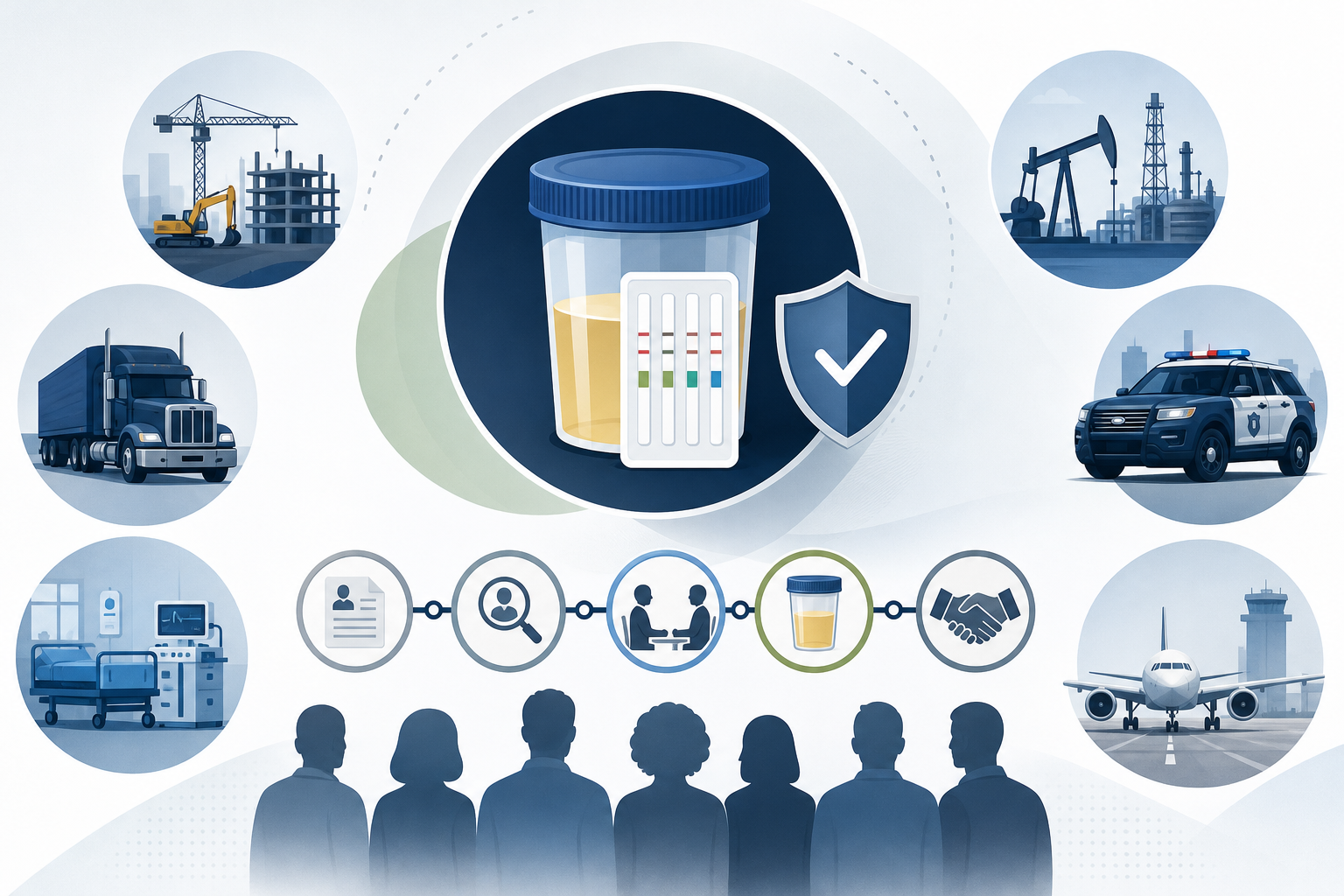
Drug testing for jobs is still common in specific industries, even in marijuana-legal states. If you are interviewing right now, you need to know which industries still test, when in the process the test happens, and what a failed or diluted result can trigger. This guide breaks down the current landscape by industry and state-level trends, then gives you practical steps you can take today so you are not surprised after you ace your behavioral interview.
Note: This article is career guidance, not legal advice. Drug testing rules vary by employer, role, union contract, and state or city law. When in doubt, ask HR for the written policy.
The current landscape of job drug testing (and why it still exists)
Drug testing has not disappeared. It has become more targeted.
Many employers have shifted away from broad, across-the-board pre-employment testing. But safety-sensitive roles, federally regulated jobs, and high-liability workplaces still test routinely. Employers also use testing to comply with federal contracts, insurance requirements, Department of Transportation rules, or internal safety policies.
At the same time, marijuana legalization has created a confusing reality: you can be allowed to use cannabis under state law and still lose a job offer due to an employer policy, a federal rule, or a safety standard.
Which industries still drug test (by likelihood)
Your best predictor is not whether your state has legalized marijuana. It is whether your role is regulated, safety-sensitive, or tied to public trust.
Transportation and DOT-regulated roles (very likely)
If the job falls under U.S. Department of Transportation (DOT) rules, testing is common and structured. This includes many roles in:
- Trucking and commercial driving (CDL)
- Transit and bus operations
- Aviation-related positions
- Rail-related positions
- Pipeline roles
What to expect:
- Pre-employment testing is common.
- Random testing can occur after hire.
- Post-accident and reasonable-suspicion testing is typical.
Practical takeaway: If your role is DOT-covered, assume testing is part of the process and that marijuana is treated differently than in non-regulated roles.
Construction, skilled trades, and heavy equipment (very likely)
Construction firms, especially those handling heavy equipment or operating under strict safety programs, often test.
Common drivers:
- Jobsite safety policies
- Workers’ compensation and insurance requirements
- General contractor requirements for site access
- Federal projects
Practical takeaway: Even if the employer does not test every role, site access rules can require it. Ask whether the jobsite has its own testing policy.
Healthcare and clinical settings (likely)
Hospitals, clinics, long-term care, and roles involving patient care frequently test due to patient safety and controlled substance handling.
Often tested roles:
- Nurses and clinical staff
- Patient care technicians
- Pharmacy-related roles
- Roles with medication access
Practical takeaway: If you will have direct patient contact or access to medication, testing is more likely.
Government, defense, aerospace, and federal contractors (likely to very likely)
Government roles vary by agency and level. Defense and aerospace employers, and many federal contractors, still test due to federal compliance expectations and security concerns.
Practical takeaway: If the posting mentions security clearance, federal contract, or export controls, assume testing may be required.
Manufacturing, warehousing, logistics, and energy (moderate to likely)
Testing varies widely. It is more common when the role involves:
- Forklifts or powered industrial trucks
- Hazardous materials
- Shift work with safety risks
- High-value inventory
- Energy production, utilities, or field work
Practical takeaway: The more the job resembles a safety-sensitive environment, the more likely testing becomes.
Finance, corporate office roles, tech, and creative roles (less likely, but not rare)
Many office-based employers have reduced pre-employment testing. But you still see testing in:
- Companies with strict risk policies
- Employers in heavily regulated fields
- Roles that require driving a company vehicle
- Internships or rotational programs at large enterprises
Practical takeaway: Do not assume “white-collar” means “no test.” Look for clues in the job posting and offer paperwork.
Education and childcare (varies)
Testing depends on the employer, role, and local rules. Some districts or childcare providers test due to safety and trust concerns.
Practical takeaway: If you will supervise children, drive a bus or van, or work in a public institution, testing becomes more plausible.
Drug testing in marijuana-legal states: what changes and what does not
Legalization has changed the conversation, but not always the outcome.
Why marijuana can still cost you an offer
Even in states with legal recreational or medical cannabis, employers may still test and act on results because:
- Federal law still classifies marijuana as illegal, and federal contractors may follow federal standards.
- Safety-sensitive roles often maintain stricter policies.
- Some employers enforce a drug-free workplace policy regardless of state law.
What has changed in some states and cities
In some places, laws restrict or shape pre-employment testing for marijuana, especially for non-safety-sensitive roles. Common approaches include:
- Limiting an employer’s ability to test for cannabis pre-employment, with exceptions.
- Requiring additional steps before adverse action.
- Creating protections for lawful off-duty conduct, sometimes with carve-outs.
Because these rules vary, your best move is to check:
- Your state labor department site
- Your city or county employment ordinances
- The employer’s written policy
Practical takeaway: If you are in a marijuana-legal state, do not guess. Ask HR, “Is a pre-employment drug screen required for this role, and does it include THC?”
When drug testing happens in the hiring timeline
Knowing the timeline helps you plan your interviews, travel, and notice period. It also reduces anxiety because you can anticipate the next step.
Most common: after a conditional offer
Many employers test after you receive a conditional offer. You pass interviews, references, and sometimes a background check first. Then the offer is contingent on passing the screen.
Typical sequence:
- Recruiter screen
- Interviews (including behavioral interviews)
- Conditional offer
- Drug test order and scheduling
- Background check completion
- Final start date confirmation
Why employers do it this way: it is cheaper and reduces unnecessary testing of candidates who will not be hired.
Sometimes: before the final interview
This happens less often, but you may see it when:
- The employer hires in high volume
- The job is urgently needed
- The role is heavily regulated
If you are asked to test early, clarify whether it is required to proceed.
Also common: on day one or during onboarding
Some employers include testing as part of onboarding, especially for roles with equipment access or site badges.
Watch for language like:
- “Must pass drug screen prior to start date”
- “Drug screen required for badge issuance”
After hire: random, post-incident, or reasonable suspicion
Even if you are not tested pre-employment, you may be tested later if:
- The employer has a random program
- There is an accident or safety incident
- A supervisor documents reasonable suspicion
Practical takeaway: If you are joining a safety-sensitive environment, ask for the policy now, not after an incident.
What kinds of tests employers use (and why it matters)
Employers typically use one of these:
- Urine test: common for pre-employment screening.
- Saliva test: often used for more recent use detection windows.
- Hair test: less common, sometimes used in high-security or high-liability environments.
- Blood test: uncommon for routine hiring.
Why this matters: detection windows differ. Also, some states regulate how tests must be administered and what confirmatory testing is required.
Practical takeaway: If the employer provides the test type in paperwork, read it carefully and follow the scheduling instructions exactly.
What happens if you fail a pre-employment drug test
A failed result usually triggers one of a few outcomes. The exact process depends on the employer policy and state rules.
Outcome 1: offer rescinded
This is the most common outcome for pre-employment failures. The employer may withdraw the conditional offer.
Outcome 2: confirmatory testing and a medical review process
Many programs include a Medical Review Officer (MRO) process. If your initial screen is positive, confirmatory testing may follow. The MRO may contact you to ask about legitimate prescriptions.
What you should do:
- Respond promptly.
- Provide documentation for prescriptions if requested.
- Keep communication factual and brief.
Outcome 3: eligibility to reapply after a waiting period
Some employers allow you to reapply after a set period. If this happens, ask HR:
- Whether you are eligible to reapply
- When you can reapply
- Whether the next offer would require another test
Outcome 4: alternative placement or restrictions (less common)
In some workplaces, a failure may lead to removing you from safety-sensitive duties. This is more typical for current employees than new hires, but it can happen.
Practical takeaway: If you receive a positive result notice, do not panic and do not argue. Ask what the next step is, whether confirmatory testing is available, and whether an MRO will contact you.
What happens after a diluted result (negative dilute or positive dilute)
Diluted results are more common than candidates expect. A diluted result can happen from drinking a lot of water, taking certain supplements, or testing later in the day.
Negative dilute
A negative dilute often means no drugs were detected, but the sample was too diluted for the lab’s preferred thresholds. Employer responses vary:
- Accept it as a pass.
- Require a retest, sometimes under direct observation.
Positive dilute
A positive dilute is treated more like a positive result. You may be contacted by an MRO and the employer may take adverse action.
What you should do if you are told your result was diluted:
- Ask whether you must retest and by when.
- Follow instructions exactly. Missed deadlines can be treated like refusal.
- Avoid overhydrating before the retest. Drink a normal amount of fluids.
Important: Do not attempt to “flush” your system. Besides being risky for your health, it increases the chance of a diluted result and a retest under stricter conditions.
Refusal to test, missed appointments, and paperwork mistakes
From an employer perspective, a refusal to test often looks the same as a failure.
Common ways candidates unintentionally trigger a refusal:
- Missing the testing window (for example, you had 24 to 72 hours to complete it).
- Showing up without valid ID.
- Leaving the collection site before completing the process.
- Not following the chain-of-custody instructions.
Practical takeaway: Treat the drug test like a final interview. Confirm the deadline, location, ID requirements, and whether you need an appointment.
How to ask about drug testing without hurting your candidacy
You can ask professionally and neutrally. The key is to frame it as logistics, not as negotiation.
Use one of these scripts:
- “To plan my schedule, can you confirm whether this role requires a pre-employment drug screen and when it typically occurs?”
- “Is the offer contingent on a drug test or background check? If so, what is the timeline for each?”
- “For this position, does the screening include THC, or is it a panel that excludes it?”
Best time to ask:
- After the recruiter screen, when discussing next steps.
- When you receive the conditional offer.
Avoid:
- Overexplaining your personal situation.
- Asking in a way that implies you might fail.
How drug testing connects to behavioral interviews (yes, it matters)
Drug testing is not a behavioral interview topic by itself, but it affects your offer timeline, start date, and how you communicate under pressure.
Scenario: your start date is at risk due to testing delays
You might be asked to handle a tight timeline or a rescheduled start date. Prepare a STAR story about being organized and proactive.
Here is a STAR example you can adapt:
- Situation: You received a time-sensitive onboarding requirement with a short deadline.
- Task: You needed to complete it while juggling work and interview scheduling.
- Action: You confirmed requirements in writing, booked the earliest appointment, prepared documents the night before, and communicated status updates.
- Result: You met the deadline and avoided delays to your start date.
Scenario: you need to explain a rescinded offer in future interviews
If an offer was rescinded due to screening, you may need to address a gap or a quick job change. You do not need to volunteer details. Keep it simple.
A safe, professional framing:
- “The role did not work out due to pre-employment contingencies, so I restarted my search and focused on positions that are a better fit.”
Then pivot back to your value.
If you want to understand how companies handle hiring steps like screenings, you can review candidate experiences and timelines in free company-specific reports at https://primly.io/community.
Practical checklist: what you should do today
Use this to avoid surprises and stay in control.
- Scan the job posting for phrases like “drug-free workplace,” “must pass drug screen,” “safety-sensitive,” “DOT,” or “federal contractor.”
- Ask the recruiter about the timeline: when the test occurs and how many hours you have to complete it.
- Request the written policy if you are unsure whether THC is included.
- Plan for logistics: ID, transportation, appointment times, and time off work.
- Do not overhydrate before the test. Follow normal routines to reduce dilution risk.
- Respond quickly to MRO outreach if confirmatory steps are needed.
- Prepare a STAR story about meeting compliance requirements under time pressure. It is surprisingly relevant in structured workplaces.
Conclusion: treat drug testing like a predictable step, not a surprise
In today’s job market, drug testing is most common in transportation, construction, healthcare, government and defense, and other safety-sensitive environments. Marijuana-legal states can change the rules around testing, but they do not eliminate employer policies or federal requirements.
Your advantage is preparation. Clarify whether a test is required, understand where it falls in the hiring timeline, and avoid preventable issues like missed deadlines or diluted results. Do that, and you can keep your focus where it belongs: delivering strong behavioral interview answers and closing the offer.