
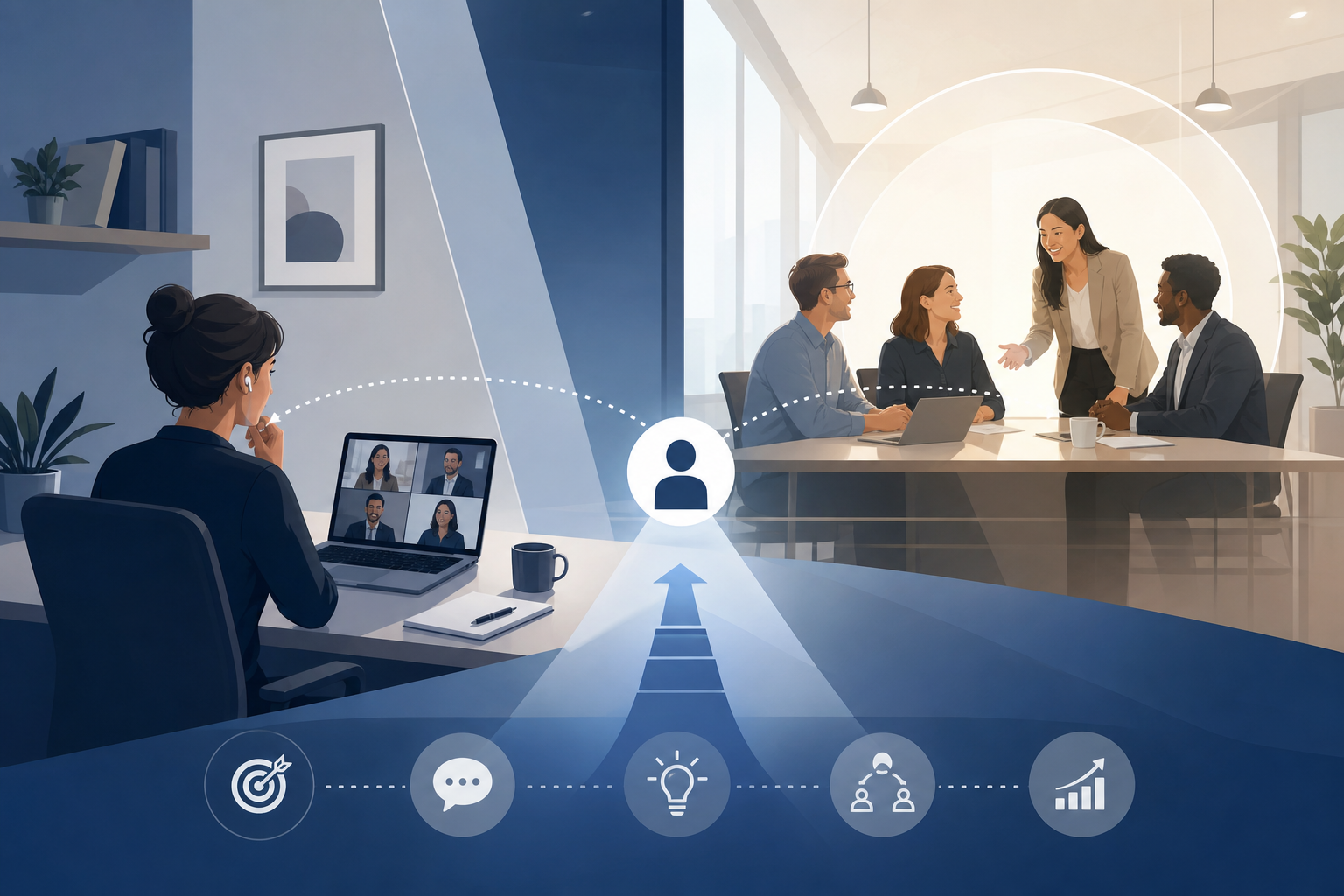
Introduction: proximity bias is real, and you can out-strategize it
Proximity bias is the tendency to favor people you see more often. In a hybrid team, that usually means the people who are physically in the office. If you are remote more days than your peers, you can be doing excellent work and still be perceived as less impactful, less engaged, or less “ready” for the next level.
This matters for career growth and positioning, and it matters for behavioral interviews. When you interview for a promotion or a new role, you are evaluated on visible impact, influence, and leadership. The good news is you can build systems that make your work legible, your progress easy to advocate for, and your presence felt without performing or overworking.
This article gives you evidence-based, practical tactics against out-of-sight-out-of-mind: visibility artifacts, strategic office days, and manager 1:1 agendas that consistently surface your work. It is written for two situations:
- You are already in-seat on a hybrid team and want to stay promotable.
- You are evaluating offers and want to predict whether hybrid will help or hurt your trajectory.
Important note: The goal is not to “game” the system. It is to reduce ambiguity so your manager and skip-level can accurately see your impact.
What proximity bias looks like in real hybrid teams
Proximity bias is rarely explicit. It shows up as small advantages that compound.
Common signals you are being affected
- Your work gets fewer shout-outs in meetings, even when outcomes are strong.
- Decisions are made informally in office conversations, then announced later.
- You are assigned execution tasks while in-office peers get higher-visibility initiatives.
- Feedback is vague: “We need to see you lead more,” without specific examples.
- Promotions lean toward people who are “known quantities” to leaders who are on-site.
Why it happens (without anyone being malicious)
Hybrid teams create information gaps. Leaders default to what is easiest to recall. Recency and frequency matter. If your manager sees a colleague in the hallway, hears their updates live, and watches them handle interruptions, that colleague can feel more “present” and “reliable,” even if your output is comparable.
Your job is to make your contributions easy to notice, easy to remember, and easy to advocate for.
The promotability formula for remote people: Impact, Evidence, Advocacy
To stay promotable as the remote person, focus on three levers.
1) Impact that maps to the next level
Promotions rarely reward effort. They reward scope, outcomes, and behaviors aligned to the level above you.
Ask: what does “senior” mean here? Is it owning ambiguous projects, influencing cross-functional partners, mentoring, or operational excellence? Your work should intentionally hit those signals.
2) Evidence that is lightweight but consistent
You need a trail of artifacts that show:
- What you delivered
- Why it mattered
- How you influenced others
- What changed because of your work
3) Advocacy that is built into your cadence
Your manager is your primary amplifier. In hybrid environments, your manager needs structured inputs to represent you accurately in calibration, performance reviews, and leadership conversations.
Visibility artifacts: make your work legible without “self-promotion”
A visibility artifact is a small, repeatable output that documents progress and outcomes. It reduces reliance on memory and hallway conversations.
Artifact 1: a weekly impact note (5 minutes)
Send a short weekly message to your manager and, when appropriate, your project channel. Keep it consistent and skimmable.
Use this template:
- Wins (outcomes): What shipped, improved, or unblocked.
- In-progress (momentum): What is on track and what you are driving next.
- Risks (help needed): Where you need decisions, resources, or alignment.
- Visibility (stakeholders): Who you partnered with and what changed.
Example:
- Wins: Reduced onboarding time for new customers by clarifying setup steps and updating docs. Support tickets on setup are trending down week over week.
- In-progress: Drafting v2 of the onboarding checklist with Support and CS. Pilot starts next Tuesday.
- Risks: Waiting on Legal feedback to publish updated terms. If delayed, launch moves by one week.
- Visibility: Aligned with CS lead on rollout plan. They will announce to the field team.
Why it works: your manager can forward it, reuse it in status meetings, and cite it in reviews.
Artifact 2: a “decision log” for projects with many stakeholders
Hybrid teams lose context fast. A decision log prevents re-litigating and shows you are operating at a higher level.
Keep a simple doc with:
- Decision
- Date
- Owner
- Options considered
- Rationale
- Follow-ups
This is not bureaucracy. It is a leadership tool that makes you the person who creates clarity.
Artifact 3: a monthly brag doc that is actually a promotion file
A brag doc is not vanity. It is your evidence bank for performance reviews, promotion packets, and behavioral interviews.
Structure it around the level above you:
- Business outcomes: revenue, cost, time, quality, risk reduced. Use real internal metrics when available.
- Leadership behaviors: influence, conflict resolution, mentoring, driving alignment.
- Cross-functional proof: quotes, Slack snippets, emails, or meeting notes that show trust.
- Before and after: what was true, what you changed, what is true now.
Tip: write entries in STAR format as you go. That makes interview prep dramatically easier later.
Strategic office days: be intentional, not frequent
If your team is hybrid, you likely have some choice about which days you are on-site. Treat office days like a high-leverage resource.
Choose office days based on leverage, not optics
Pick days when:
- Your manager or skip-level is present.
- Cross-functional partners are present and decisions can be made faster.
- There are planning sessions, retros, roadmap reviews, or customer readouts.
- You can run a working session that removes a key dependency.
Avoid using office days for deep solo work. Do that remotely when you control your environment.
Use a simple office-day plan (before, during, after)
Before:
- Book 2 to 3 short meetings with the people who influence your work.
- Bring a one-page agenda for any working session.
- Identify one decision you want to get made.
During:
- Ask one thoughtful question in a meeting that shows strategic thinking.
- Volunteer to synthesize or document outcomes. That becomes an artifact.
- Do one relationship-building action: quick coffee, intro, or thank-you.
After:
- Send a recap with decisions, owners, and next steps.
- Update your weekly impact note and brag doc.
Make “presence” about contribution
You do not need to be seen at your desk. You need to be seen driving clarity, alignment, and outcomes.
Manager 1:1 agendas that surface your work (and your next-level behaviors)
Your 1:1 is your best tool to counter proximity bias. Many remote employees waste it on status updates that could have been a message. Use your 1:1 to shape perception and unlock advocacy.
Run a consistent 1:1 agenda
Use a shared doc with these sections:
- Top outcomes since last 1:1 (2 to 3 bullets)
- What I am driving next (1 to 2 priorities)
- Decisions I need from you (clear asks)
- Risks and tradeoffs (what could slip, what you recommend)
- Promotion and growth (one signal you are building)
This structure keeps you out of “busy work reporting” and into leadership conversations.
Ask promotability questions directly
Every 4 to 6 weeks, ask questions that force specificity:
- “What would make you confident I am operating at the next level?”
- “Which two behaviors should I demonstrate more visibly?”
- “In calibration, what examples of my impact are you using?”
- “What projects in the next quarter have the highest visibility and why?”
If your manager struggles to answer, that is a signal you need stronger artifacts or clearer alignment on expectations.
Build a sponsor map, not just a manager relationship
Promotions often require more than one voice. Identify 2 to 4 people whose opinions matter:
- Skip-level leader
- Key cross-functional partner
- Senior peer who is respected
- Customer-facing leader who feels the impact
Then create lightweight touchpoints: monthly check-ins, short demos, or written updates. Your goal is to make it easy for them to say, “Yes, I have seen their work, and it matters.”
Meeting strategy for remote people: be memorable for the right reasons
You do not need to talk more. You need to contribute in ways that stick.
Use the “pre-wire” tactic
If a meeting is likely to decide something important, do not wait for the live conversation. Message key stakeholders beforehand:
- Share your recommendation
- Ask what concerns they have
- Offer to adjust based on their constraints
Then in the meeting, you can summarize: “I spoke with X and Y. The main concern was Z. Here is the revised proposal.” That is leadership, and it is highly visible.
Own the recap
Remote employees often lose informal follow-ups. If you send the recap, you control the narrative and create an artifact.
A good recap includes:
- Decisions made
- Open questions
- Owners and deadlines
- Risks
What to do if you are evaluating a hybrid offer
If you are job searching, hybrid can be a growth accelerator or a career stall. Ask targeted questions in interviews to assess proximity bias risk.
Questions that reveal how promotions work in hybrid teams
- “How do performance reviews work for hybrid employees?”
- “What does promotability look like for this role at 6 and 12 months?”
- “How do you ensure remote team members get high-visibility projects?”
- “How are decisions documented and communicated when some people are on-site?”
- “Who was promoted recently, and what kinds of impact did they demonstrate?”
Listen for systems, not slogans. “We treat everyone equally” is less useful than “We use written updates, documented goals, and calibration packets with examples.”
Watch for subtle red flags
- Leaders emphasize “face time” or “being around” without defining outcomes.
- Key meetings are described as “usually in the office” with no remote plan.
- The team relies on informal alignment and ad hoc conversations.
Use external intel when you can
If you want to understand how a company tends to run interviews and evaluate candidates, you can review free, company-specific interview reports at https://primly.io/community. Use that context to tailor your behavioral stories to what the company values.
Turn your hybrid experience into strong behavioral interview answers
Proximity bias is not just a workplace problem. It is also a source of great interview stories because it forces you to lead through influence, documentation, and alignment.
STAR story 1: creating visibility artifacts that improved execution
Use this when asked: “Tell me about a time you improved a process.”
Make it stronger by adding specifics you can prove: what shipped, what cycle time changed, what risk you avoided, or what stakeholders said.
STAR story 2: influencing without being in the room
Use this when asked: “Tell me about a time you influenced someone.”
STAR story 3: strategic office days to unblock a critical dependency
Use this when asked: “Tell me about a time you handled competing priorities.”
These stories demonstrate senior behaviors: driving alignment, making decisions durable, and reducing organizational friction.
Your 30-day action plan to stay promotable in a hybrid team
If you want immediate traction, implement this in the next month.
Week 1: set the foundation
- Start a brag doc aligned to the next level.
- Create a shared 1:1 agenda doc with your manager.
- Ask: “What are the top two outcomes that matter most this quarter?”
Week 2: create your first visibility artifacts
- Send your first weekly impact note.
- Start a decision log for your highest-stakes project.
- Own one meeting recap end-to-end.
Week 3: make office days strategic
- Pick one office day based on who will be there.
- Book two short touchpoints with stakeholders.
- Leave with one decision made or one dependency cleared.
Week 4: secure advocacy
- Ask your manager: “In calibration, what examples will you use for me?”
- Identify two potential sponsors and schedule brief check-ins.
- Convert one brag doc entry into a polished STAR story for interviews.
Conclusion: you do not need more visibility. You need better evidence.
Proximity bias is real in hybrid teams, but it is not unbeatable. When you build consistent visibility artifacts, choose office days for leverage, and run 1:1 agendas that surface outcomes and next-level behaviors, you make your impact easy to recognize and easy to advocate for.
This approach also makes you interview-ready. You will have a bank of STAR stories that prove influence, leadership, and results, which is exactly what promotion committees and hiring managers look for.
If you implement just two habits, make them these: a weekly impact note and a monthly brag doc. They compound over time, and they keep you promotable even when you are not in the room.